8 min read
Surveyors.io Editorial
Wetland delineation Pennsylvania cost and the Chapter 105 permit fees DEP charges after Sackett
Oct 23, 2026 · 8 min read
The price range and turnaround for the job you describe appear here.
Traverse
Estimate for ,
typical local range · on site to drawing
A published range for this type of work, not a quote. Send the request and surveyors listed for your county reply with their own price.
Free for clients · You choose who to talk to
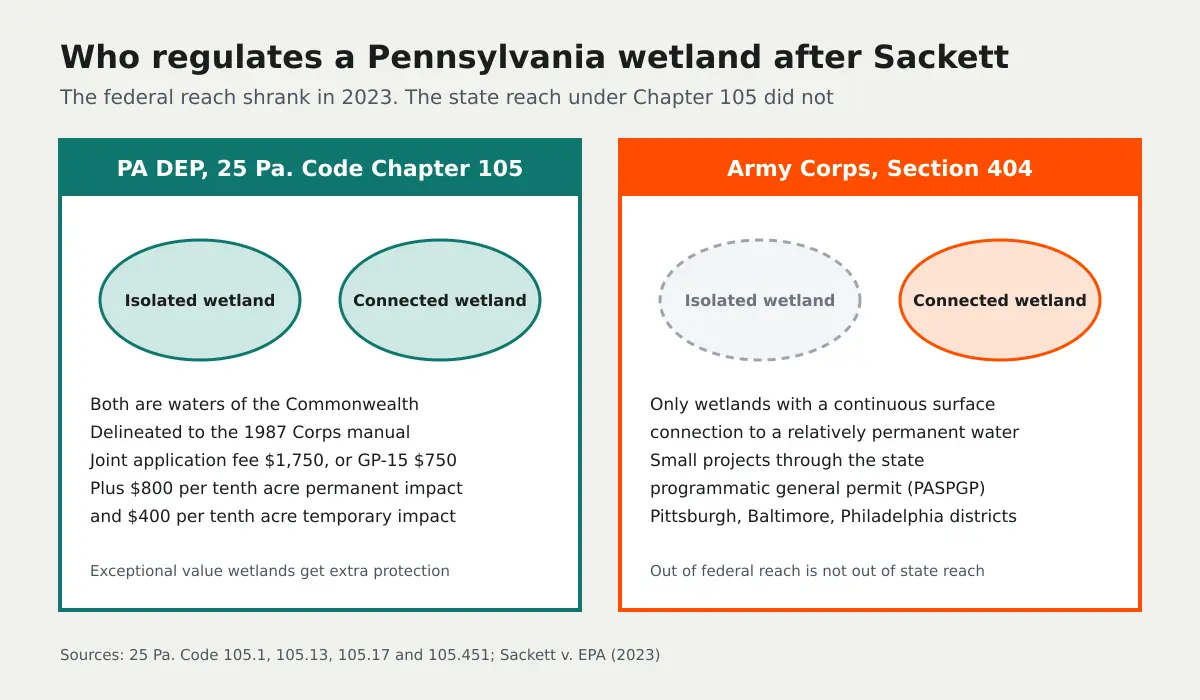
A wetland delineation in Pennsylvania costs about $2,500 to $4,500 on a parcel under two acres, $4,000 to $6,000 at five acres and $6,000 to $14,000 on a 10 to 20 acre tract, and a Pennsylvania licensed land surveyor's map of the flagged line adds $1,200 to $4,000. The 2023 Sackett decision narrowed which wetlands the Army Corps regulates, but it did not change Pennsylvania law: DEP regulates wetlands as waters of the Commonwealth under 25 Pa. Code Chapter 105, isolated or not, and charges $800 in review fees for every tenth of an acre you permanently disturb.
That makes "the feds dropped my wetland" the most expensive misreading a Pennsylvania builder or land buyer can make. The useful question is not whether the Corps cares. It is how much of the parcel DEP will treat as wetland, whether any of it is exceptional value, and what it will cost to build around it or permit through it.
How much does a wetland delineation cost in Pennsylvania?
Consultants price the field and report work by acreage and by how hard the wet to dry transition is to read. A Lancaster County lot with one wet swale is quick. A wooded Poconos tract with seeps, hummocks and old drainage ditches takes days. The method is the same statewide: a desktop review of soil survey maps, the National Wetlands Inventory and aerials, then field data on vegetation, soils and hydrology at sampling points, flags along the boundary and a report written to the Corps manual.
| What you are buying | Typical Pennsylvania cost | Who you pay |
|---|---|---|
| Delineation and report, under 2 acres | $2,500 to $4,500 | Wetland consultant |
| Delineation and report, about 5 acres | $4,000 to $6,000 | Wetland consultant |
| Delineation and report, 10 to 20 acres | $6,000 to $14,000 | Wetland consultant |
| Large or complex tract, about 40 acres | $18,000 to $28,000+ | Wetland consultant |
| Survey of the flagged line, floodway and lot lines on one sealed plan | $1,200 to $4,000 | Pennsylvania licensed land surveyor |
| Support for an approved jurisdictional determination from the Corps | $1,500 to $5,000 | Wetland consultant |
| DEP joint application administrative filing fee (individual permit) | $1,750 plus disturbance fees | DEP |
| GP-15 registration, private residential construction in wetlands | $750 plus disturbance fees | DEP |
| Disturbance review fee, wetlands, floodways and waterways | $800 per tenth acre permanent, $400 per tenth acre temporary, 0.1 acre minimum | DEP |
The consultant and surveyor figures are market ranges for 2026; we did not find a published Pennsylvania delineation price from a consultant or a public contract, so treat a quote far outside them as a reason to ask what is in the scope. The DEP numbers are not estimates. They come from the fee schedule in 25 Pa. Code 105.13. Impacts are rounded up to the next tenth of an acre and each tenth is billed, so filling a quarter acre of wetland for a driveway and house pad adds $2,400 in disturbance fees (three tenths at $800) on top of the registration or filing fee. County conservation districts may charge their own review fees as well, and a minor road crossing registered under GP-7 costs $350 before disturbance fees.
Does Pennsylvania regulate isolated wetlands after Sackett?
Yes. Chapter 105 defines wetlands by what is on the ground, not by a connection to navigable water: areas inundated or saturated by surface water or groundwater often enough and long enough to support, and that under normal circumstances do support, a prevalence of vegetation adapted to saturated soil, including swamps, marshes and bogs. Nothing in that definition asks whether a wetland touches a river. The Clean Streams Law reaches all waters of the Commonwealth, which Pennsylvania environmental lawyers have described since Sackett as broader than the federal limit under any reading.
What Sackett changed is the federal half. The Corps now regulates only wetlands with a continuous surface connection to a relatively permanent water. A wet pocket in a farm field that the Corps walks away from is still a Pennsylvania wetland, and filling it still needs a Chapter 105 authorization. You may need one approval instead of two, which can save time. It rarely makes the delineation optional.
Which delineation method does DEP accept?
The same one the Corps uses. Under 25 Pa. Code 105.451, DEP adopts the 1987 Corps of Engineers Wetland Delineation Manual, with the Corps' March 6, 1992 clarification memo and later changes, as the method for identifying and delineating wetlands in the Commonwealth. In practice that means one competent report serves both agencies. Do not pay for two delineations, and be wary of a cheap report that does not follow the manual, because DEP can reject it and you pay for the field work twice.
The delineation also has to land on a plan. A Chapter 105 application needs a complete demarcation of the floodplains and regulated waters on the site, with the wetlands delineated under 105.451, shown against the existing roads, utility lines, lots, structures, contour lines and drainage patterns. That is a survey drawing, and it is the part of the job you hire a Pennsylvania Professional Land Surveyor for. Most township subdivision and land development reviews ask for the same line on the subdivision plan.
Exceptional value wetlands are where budgets break
Chapter 105 sorts wetlands into exceptional value wetlands and all others, and the first group gets special protection. Under 105.17 a wetland is exceptional value if it is habitat for a threatened or endangered species, is hydrologically connected to or within half a mile of such a wetland and maintains that habitat, lies in or along the floodplain of a wild trout stream or exceptional value water (or their tributaries), sits along a public or private drinking water supply that it helps maintain, or lies in a designated natural or wild area, federal wilderness or national natural landmark.
Ask the consultant to screen for every one of those triggers before you sign a purchase agreement. The wild trout test catches many owners off guard, because Pennsylvania lists a long roster of wild trout streams and the test also covers tributaries. A two acre lot that looks like an easy build can turn into a hard permit if a seep at the back drains to one.
How long does a Pennsylvania wetland delineation take?
On a small parcel the field visit is usually one or two days and the report two to four weeks, with the survey crew locating the flags alongside. Season matters more here than in the South. Snow cover and frozen ground hide soils and hydrology from roughly December to March, and a dry August can make a wetland look like upland, so a careful consultant will say which way the conditions cut. If you want to file in spring, book the delineation the previous growing season. Corps jurisdictional determinations and DEP permit reviews add their own queues on top.
How to keep a Pennsylvania delineation inside budget
Before you buy, check the parcel against the National Wetlands Inventory and the county soil survey, look for a mapped floodway, and find out whether any stream on or near the land is a listed wild trout or exceptional value water. Then hire one consultant to delineate to the 1987 manual so the report serves DEP, the Corps and the township, and put a surveyor on the same calendar so the flags are located before they fade or get pulled. Order the boundary survey on the same visit if you need one anyway, because one crew mobilization for the flags and the lot lines costs less than two.
If you are lining up a consultant, a survey crew and an excavator for the same lot, collect each one's certificate of insurance before anyone works near the wetland line, since damage to a regulated area is the claim nobody wants to argue about later. And put the delineation in the purchase contract as a contingency with enough time for DEP to answer, because a wetland line that arrives after your due diligence period ends buys you nothing.
Describe the parcel once above and we will match you with up to three licensed surveyors who work your county and coordinate with wetland consultants. For the national price picture see wetland delineation cost, for the consultant side the wetland delineation services page, and if you are dividing the land as well, the cost to subdivide land in PA guide covers township, county and DEP fees. Local surveyor coverage is on land surveyors in Pennsylvania.
Need it done right? Send one scoped request to licensed land surveyors near you and compare what they quote. Free for clients.