8 min read
Surveyors.io Editorial
Elevation certificate NJ cost and the New Jersey flood rules that set your floor height
Oct 1, 2026 · 8 min read
The price range and turnaround for the job you describe appear here.
Traverse
Estimate for ,
typical local range · on site to drawing
A published range for this type of work, not a quote. Send the request and surveyors listed for your county reply with their own price.
Free for clients · You choose who to talk to
An elevation certificate in New Jersey typically costs $400 to $1,000 for an existing single-family home, with published New Jersey firm prices running from $400 to $800 up to a $1,000 flat fee. New construction in a flood zone needs two certificates, one at the foundation and one when the house is finished, so budget $800 to $1,800 for the pair. Check your township first: many keep certificates on file by block and lot, sometimes at no charge.
Two New Jersey rules changed who asks for these certificates. Since March 20, 2024, a seller has to tell the buyer whether a FEMA elevation certificate exists and hand it over if it does. And the state's flood rules now put new floors well above the FEMA base flood elevation, which means a builder who sets the foundation at the old height finds out at the foundation inspection, with the certificate in hand.
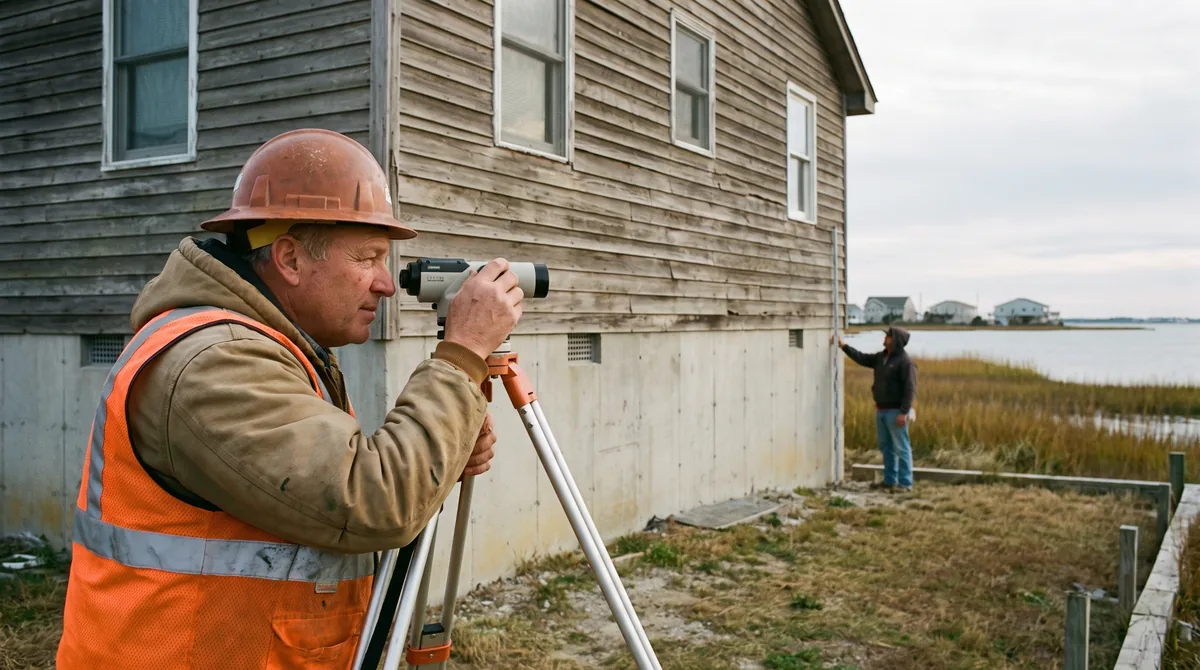
How much does an elevation certificate cost in NJ?
For an existing house, the price is mostly one field visit and an evening of office work. The things that move it are access, the number of floors and enclosures the surveyor has to measure, and whether the township has a benchmark nearby or the crew has to carry elevation in from farther away.
| What you order | Typical New Jersey cost | When you need it |
|---|---|---|
| Copy of a certificate on file with the township | Often free, sometimes a copy fee | The house has not changed since the certificate was made |
| New certificate, existing single-family home | $400 to $1,000 | Sale, flood insurance quote, lender, no copy on file |
| Raised Shore home on piles with an enclosure, or several additions | $700 to $1,500 | More levels, openings and equipment to measure |
| Foundation certificate, new home or substantial improvement | $400 to $900 | Required before any further vertical construction |
| Finished construction certificate | $400 to $900 | Before the certificate of occupancy |
| Survey data for a LOMA or LOMR-F | $400 to $900 plus any FEMA fee | Proving the lot or the house sits above the flood elevation |
Turnaround after the site visit is usually a few business days; firms that publish it quote 3 to 7 business days for an elevation survey, longer in spring when every Shore closing wants one at once. Order the foundation and finished certificates from the same firm. The crew that shot the foundation already has the benchmark and the lot set up, so the second visit goes faster and the two documents agree with each other.
Where can I find an elevation certificate for my house in NJ?
Start with the municipality, not a surveyor. New Jersey has no single statewide archive of elevation certificates, but many flood-prone towns keep every certificate submitted with a building permit, and some publish them. Ocean City lists all of its elevation certificates by block and lot, kept by the Engineering Department from the copies on file with the Construction Code Office. Highlands Borough posts certificates online at no cost and will copy one on request within three business days, with no charge for the service.
If the town has nothing, ask the seller (the 2024 disclosure law makes this a required answer), your insurance agent, the builder, and the closing folder from the last sale. A certificate you find is only worth using if it still describes the building. An addition, an enclosed area under the house, a raised floor, new machinery or a new flood map for your area all mean a new certificate.
Do sellers have to provide an elevation certificate in NJ?
Yes, if one exists. New Jersey's flood disclosure law, P.L. 2023, c. 93, in effect since March 20, 2024, adds flood questions to the seller's disclosure, including "Is there a FEMA elevation certificate available for the property? If so, the elevation certificate must be shared with the buyer." The seller does not have to order a new one, but has to disclose past flood insurance claims and hand over any certificate they hold.
The same law reaches rentals. Landlords give tenants a state Flood Risk Notice that says whether the unit sits in a special flood hazard area or a moderate risk area on the effective or preliminary FEMA map, and whether it has had flood damage. If you own several rental buildings, the certificates you already hold answer most of those questions, and if they are scattered across scanned township files, document data extraction software can pull the lowest floor and flood zone fields from each PDF into one sheet so every notice matches its certificate.
For a buyer, the practical move is to ask for the certificate during attorney review. If the seller has none and the house is in a mapped flood zone, ordering one before the inspection contingency expires costs a few hundred dollars and tells you what the flood insurance will actually cost.
Is an elevation certificate required in NJ?
For new construction and substantial improvements in a flood hazard area, yes. The Uniform Construction Code at N.J.A.C. 5:23-2.18 requires the foundation location survey, with the lowest floor elevation and elevation certificates, to go to the construction official and the floodplain administrator before any further vertical construction, and that survey must be prepared by a land surveyor licensed in New Jersey. Towns then require a finished construction certificate before they issue the certificate of occupancy.
For buying flood insurance on an existing house, no. Under FEMA's current rating method an elevation certificate is no longer required to purchase coverage, but you can submit one to your insurer to see whether it lowers the premium. It often does when the lowest floor sits above the base flood elevation.
How high does a new house have to be in a New Jersey flood zone?
Higher than FEMA's map says, and that is the number your certificate is checked against. The state's Inland Flood Protection Rule, in effect since July 17, 2023, sets the flood hazard area design flood elevation three feet above the FEMA 100-year flood elevation where FEMA fluvial mapping is used, or two feet above the DEP's own delineated flood profile. The lowest floor of a single-family home or duplex then has to sit at least one foot above that design flood elevation.
| Where the lot is | Design flood elevation | Lowest floor of a new home |
|---|---|---|
| Inland (fluvial), FEMA mapping, N.J.A.C. 7:13-3.4(e) | FEMA 100-year + 3 ft | At least 1 ft above that, so FEMA 100-year + 4 ft |
| Inland, DEP delineation, N.J.A.C. 7:13-3.3(b) | DEP flood profile + 2 ft | At least 1 ft above that |
| Tidal, under the REAL amendments adopted January 2026 | Climate-adjusted flood elevation, FEMA 100-year + 4 ft | Confirm the effective date and transition with the township |
| Any flood zone, building code floor | Uniform Construction Code | Never lower than the UCC requires (N.J.A.C. 7:13-12.5(i)) |
That gap is where money gets lost. A foundation set to the FEMA base flood elevation can be three or four feet too low under state rules, and the foundation certificate is the document that shows it. Have your surveyor set the floor elevation with the architect before the forms go in, and order the foundation certificate the day the foundation is done, before framing.
Who can do an elevation certificate in NJ?
FEMA lets a land surveyor, engineer or architect authorized by state law to certify elevation information sign the form. In New Jersey, the foundation location survey that carries the certificate on a new build must come from a licensed New Jersey land surveyor, and in practice surveyors complete nearly all certificates for existing homes too. Check the license on the Division of Consumer Affairs lookup before you hire; our New Jersey land surveyors page links it and covers what a New Jersey survey costs.
When a certificate can take you out of the flood zone
If the certificate shows the lowest adjacent ground or the lot itself above the base flood elevation, a FEMA LOMA or LOMR-F may remove the building from the mapped special flood hazard area, and with it the lender's flood insurance requirement. The LOMA flood zone removal guide walks through the filing, and the LOMR-F survey page covers lots that were raised with fill. If you are building on a lot with wetlands as well as a flood zone, the NJDEP letter of interpretation cost guide covers the other state approval you will likely need.
How do I get an accurate quote?
Give every surveyor the same facts so the quotes compare:
- Block and lot, and the flood zone on the current or preliminary FEMA map.
- Existing house or new construction, and which stage you need (foundation, finished, or both).
- Whether the house is on piles or piers, has an enclosure, a garage, a basement or crawl space below the flood elevation.
- Your deadline: closing date, attorney review, insurance renewal or the foundation pour.
- Whether you also want LOMA data or a boundary survey on the same visit.
Surveyors.io takes that description once and gets you up to three quotes from licensed New Jersey land surveyors, usually within a day. For the national picture on prices and how to read the form, see the elevation certificate cost guide.
Need it done right? Send one scoped request to licensed land surveyors near you and compare what they quote. Free for clients.