9 min read
Surveyors.io Editorial
NJDEP wetlands letter of interpretation cost and fees for a New Jersey lot, with the delineation and the survey
Sep 30, 2026 · 9 min read
The price range and turnaround for the job you describe appear here.
Traverse
Estimate for ,
typical local range · on site to drawing
A published range for this type of work, not a quote. Send the request and surveyors listed for your county reply with their own price.
Free for clients · You choose who to talk to
An NJDEP freshwater wetlands letter of interpretation (LOI) costs a $1,000 state application fee for a presence/absence, footprint or line delineation LOI, and $1,000 plus $100 per acre for a line verification LOI. That fee is the small part. The wetland delineation and the signed and sealed survey the DEP requires with every LOI except a whole-site presence/absence request bring a typical total to about $2,500 for a small lot the DEP flags itself and $7,000 to $11,000 for a 5-acre site.
The fees below come from the fee table in the Freshwater Wetlands Protection Act Rules, N.J.A.C. 7:7A-18.1. The consultant and survey figures are market ranges from New Jersey quotes, not a price list. If you are here because a planning board, a building department or a buyer asked for an LOI, the useful questions are which of the three LOI types you need, who has to flag the line, and how long the answer takes.
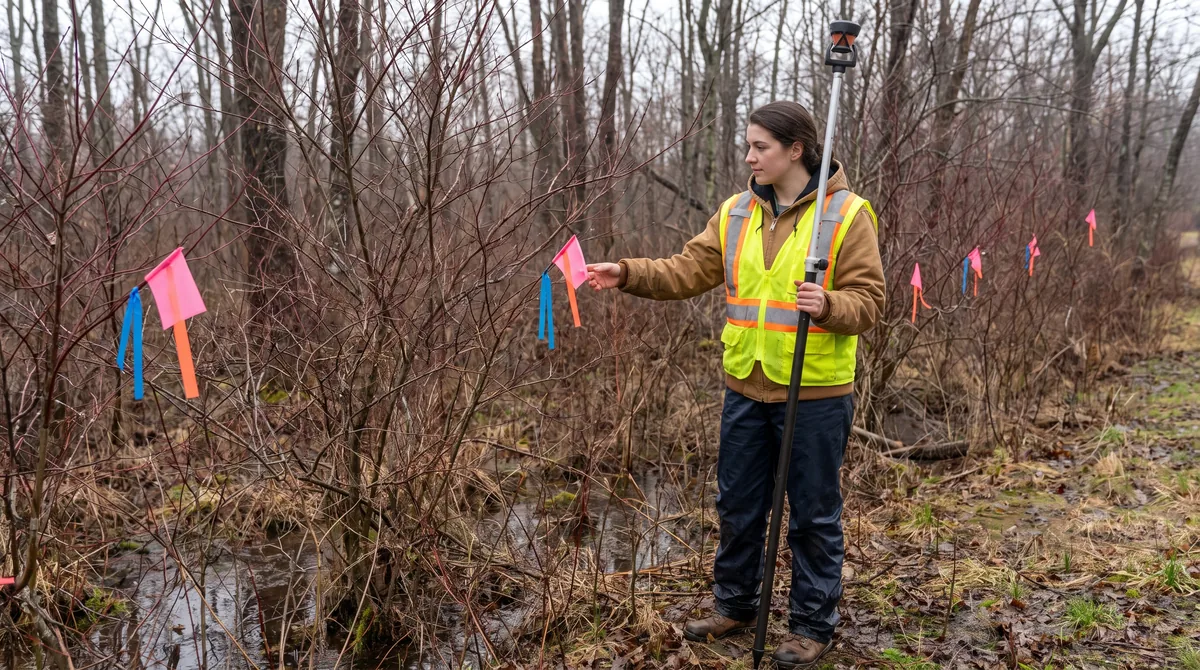
How much does an NJDEP letter of interpretation cost?
Here is every line you are likely to pay, with the state fee as written in the rule and typical market ranges for the professional work.
| Cost line | Amount | Source or basis |
|---|---|---|
| DEP fee, presence/absence LOI (whole site) | $1,000 | N.J.A.C. 7:7A-18.1, Table 18.1 |
| DEP fee, footprint of disturbance LOI | $1,000 per footprint, up to three footprints of 1 acre or less | 7:7A-18.1 and 7:7A-4.3(d) |
| DEP fee, line delineation LOI (site or tax lot of 1 acre or less) | $1,000 | 7:7A-18.1 and 7:7A-4.4 |
| DEP fee, line verification LOI | $1,000 plus $100 per acre of the site or fraction | 7:7A-18.1 (a 5-acre site is $1,500, a 20-acre site $3,000) |
| Wetland consultant delineation and data sheets | $2,500 to $4,500 under 2 acres, $4,000 to $6,000 around 5 acres | Market range; needed for a line verification LOI |
| Signed and sealed survey of the flags or footprint | $1,200 to $4,000 | Market range; required for every LOI except a whole-site presence/absence (7:7A-16.3(a)4) |
| Public notice (neighbors within 200 feet, municipal and county offices, newspaper) | Postage and a legal notice, often a few hundred dollars | 7:7A-17.3 and 17.4; our estimate, depends on neighbor count |
| Extra DEP site visit caused by the applicant | Up to $1,000 per visit | 7:7A-18.1(e) |
| Extension after 5 years | $500, or for a verification LOI 50% of the original fee or $500, whichever is greater | 7:7A-18.1 and 7:7A-4.6 |
The two professional lines move the total far more than the state fee. A consultant who knows the local soils and the DEP reviewers will flag a clean line on the first try; a sloppy line gets modified by the DEP, which is where the extra site visit fee and a second survey visit come from. That is the case for comparing quotes on the same written scope rather than picking the lowest number.
Which LOI do I need?
The DEP issues three types, and choosing the wrong one is the most expensive mistake in this process because you pay the fee again for the right one.
| LOI type | What the DEP tells you | Who draws the line | Best for |
|---|---|---|---|
| Presence/absence, whole site | Whether wetlands, transition areas or state open waters exist, and the resource value class. No boundaries | Nobody, no line is drawn | A lot you believe is dry, where you only need a yes or no for the file |
| Presence/absence, footprint of disturbance | The same answer for a marked area of 1 acre or less | Nobody, but the footprint must be surveyed and marked on the ground | An addition, pool or garage on a larger lot with wetlands elsewhere |
| Line delineation | The boundary of wetlands and transition areas, plus the resource value class | The DEP inspects and flags it; you survey the flags | A house lot or tax lot of 1 acre or smaller |
| Line verification | Confirms or modifies a boundary you propose, plus the resource value class | Your consultant flags it, your surveyor maps it, the DEP checks it | Any site over 1 acre, subdivisions, commercial sites |
For a small residential lot, the line delineation LOI is the quiet bargain: the DEP does the flagging itself, so you skip the consultant and pay only the $1,000 fee, the survey of the flags and the notice. It is only available for a site or municipal tax lot of 1 acre or less. Anything larger needs a line verification, with a consultant's delineation and soil and vegetation data sheets for each sample point.
Why the resource value class decides what you can build
Every LOI that finds wetlands also classifies them, and the class sets the transition area (the regulated buffer) you cannot build in without a waiver:
- Exceptional resource value: wetlands that discharge to FW-1 or FW-2 trout production waters or their tributaries, or that are present or documented habitat for threatened or endangered species. Standard transition area 150 feet.
- Intermediate resource value: every wetland that is neither exceptional nor ordinary. Standard transition area 50 feet.
- Ordinary resource value: drainage ditches, swales, detention basins built in former uplands, and isolated wetlands under 5,000 square feet mostly surrounded by lawns, pavement and similar uses. No transition area.
On a half-acre lot, the difference between 50 and 150 feet can be the difference between a buildable house site and none. That is why buyers of wooded New Jersey lots order the LOI before the contingency runs out, and why a builder with a septic field or an addition near the tree line orders it before paying an architect. A transition area waiver, if you need one, carries its own DEP fee of $1,000 plus $100 per acre of disturbed regulated area.
One rule catches farm and former farm parcels: where hydric soils were drained with tiles or ditches, the DEP presumes the area still has wetland hydrology unless the drainage is removed or disabled and the area left alone for at least a normal rainfall year. A field that looks dry can still come back as wetland on the LOI.
How long does an NJDEP letter of interpretation take?
The rule sets the clock. The DEP must issue the LOI within 30 days of receiving the application if it asks for nothing more, or within 45 days after it receives enough information to call the application complete. A site inspection, which is normal for delineation and verification LOIs, adds 45 days. So plan on roughly 30 to 90 days after filing, and add the time before filing: the consultant's field work, the survey, and public notice, which you send no more than 30 days before you submit.
Season matters too. If the resource value depends on species habitat that cannot be judged under snow, the DEP can offer you the exceptional classification now or make you wait until conditions allow a decision. Filing in late winter for a spring permit is a common way to lose a quarter.
How long is a letter of interpretation valid?
Five years from issuance. You can rely on it for that period unless it was based on inaccurate or incomplete information. It can be extended for up to five more years if the underlying information is still valid, but the written request has to reach the DEP before the LOI expires and no more than one year before the expiration date. Miss that window and you start over with a new application and a new fee. Put the date in your calendar the day the letter arrives.
What the survey has to show, and why a land surveyor is on the job
Every LOI except a whole-site presence/absence request must include a survey, and any survey or site plan filed with the application has to be signed and sealed by the appropriate licensed professional under 7:7A-16.2(h). For a line verification, that means a New Jersey licensed land surveyor locates each numbered flag the consultant hung, draws the proposed wetland and transition area lines, and ties them to the property boundary. For a footprint request, the surveyor draws the footprint and it has to be marked on the ground as well.
If you also need a boundary survey or a topographic plan for the house design, order it on the same visit. One crew mobilization for the flags, the lot lines and the grades is cheaper than three, and the planning board, the DEP and your engineer then work from the same drawing. Our wetland delineation services page lists what to ask a consultant, the national wetland delineation cost guide shows how New Jersey compares with other states, and the New Jersey land surveyor page covers licensing and local survey prices.
Do I need an LOI to get a building permit in New Jersey?
Not by default, but often in practice. An LOI grants no permission to build anything; it only fixes where the wetlands are and how they are classified. The rule expressly lets a municipality or county require one as a condition of application completeness or approval, and many planning boards do for subdivisions and site plans near mapped wetlands. If you are going to need a general permit, a transition area waiver or an individual permit anyway, having the LOI first makes those applications cleaner. The DEP fee for an individual permit for one single-family home not part of a subdivision is $2,000; for anything else it is $5,000 plus $2,500 per acre of disturbed regulated area.
If a classification or a modified line goes against you and you are weighing a challenge, it helps to see how earlier disputes went before paying for expert reports; searching prior New Jersey wetlands decisions gives your attorney a head start on the arguments that have worked.
What to send when you ask for LOI quotes
- The address, block and lot, acreage and municipality.
- Which LOI type you think you need, or what you plan to build and where, so the firm can tell you.
- Any wetlands, streams, ditches or ponds you know of on or next to the lot.
- Your deadline: the contingency date, the planning board filing date or the permit date.
- Whether you also need a boundary or topographic survey on the same plan.
- Whether the firm prepares and sends the public notice and files the application, or only delivers the plan.
Surveyors.io takes that description once and gets you up to three quotes from licensed New Jersey land surveyors, usually within a day, so the survey side of your LOI is priced before you commit to a consultant or a filing date.
Need it done right? Send one scoped request to licensed land surveyors near you and compare what they quote. Free for clients.