Title survey NYC and Long Island buyers order before closing, with cost and surveyor quotes
A title survey is the boundary survey a New York buyer orders so the title company will insure the property without the blanket exception "subject to any state of facts an accurate survey would show." On Long Island it usually costs $550 to $1,300 and in the five boroughs $900 to $2,500 or more. If the seller has an older survey, the title company can instead run a survey inspection, capped by state regulation at $75 plus the inspector's cost, but the old survey's certifications do not transfer to you or your lender.
Licensed surveyors · scoped requests · free for clients Up to 3 quotes, matched to your parcel
The price range and turnaround for the job you describe appear here.
Traverse
Estimate for ,
typical local range · on site to drawing
A published range for this type of work, not a quote. Send the request and surveyors listed for your county reply with their own price.
Free for clients · You choose who to talk to
What a title survey is in New York and who actually orders it
The New York State Association of Professional Land Surveyors defines it plainly in its Code of Practice: a title survey is "a boundary survey map made for the purpose of the transfer of real property." The surveyor researches the deed and the filed map, locates the lot lines in the field, plots the house, garage, fences, stoops, driveways and walls, and shows where each one sits relative to the lines. The map is signed, sealed with the "Licensed Land Surveyor" seal, and certified to the people relying on it for this closing.
In practice you rarely call the surveyor yourself. Your attorney orders title, the title company asks whether a survey exists, and if not, the title company or your attorney orders one from a licensed surveyor and passes the cost through on the closing statement. You can also hire the surveyor directly and have the map certified to your lender and title company, which is often faster when the contract date is tight.
Who buys this: someone in contract on a house in Queens, Brooklyn, Staten Island, the Bronx, Nassau or Suffolk whose attorney has just said the title company needs a survey. The job is small, the deadline is not, and a surveyor who already works your block is the difference between a map in a week and a pushed closing.
How much does a title survey cost in NYC and on Long Island?
A new title survey costs $550 to $1,300 for a typical Long Island lot and $900 to $2,500 or more for a lot in the five boroughs, where attached houses, party walls and thin monument records take longer. Using the seller's survey is cheaper but buys less, as the next table shows.
| What you are paying for | Typical cost | Who orders it |
|---|---|---|
| New title survey, Long Island one-family lot (Nassau or Suffolk) | $550 - $1,300 | Title company, attorney or buyer |
| New title survey, detached house in Queens, Staten Island or the Bronx | $900 - $1,800 | Title company, attorney or buyer |
| New title survey, attached or semi-attached row house, party walls | $1,200 - $2,500+ | Title company, attorney or buyer |
| Update and recertification by the firm that made the old survey | $150 - $400 | Buyer or attorney, from that firm |
| Survey inspection of the seller's survey by the title company | $75 plus the inspector's cost (state cap) | Title company |
| Elevation certificate on a coastal or flood zone lot, same visit | $400 - $900 | Buyer, for insurance or a LOMA |
The $75 figure is the residential closing fee cap in New York's title insurance regulation (11 NYCRR 228.5(a)(6)), which also says the cost of a survey itself is billed as a pass through. Survey prices are market ranges, not a statute. The cheapest real survey is usually an update by the original firm, if it still exists and the house has not changed. For the wider state picture see land surveyors in New York.
What the title company does with no survey, an old survey or a new one
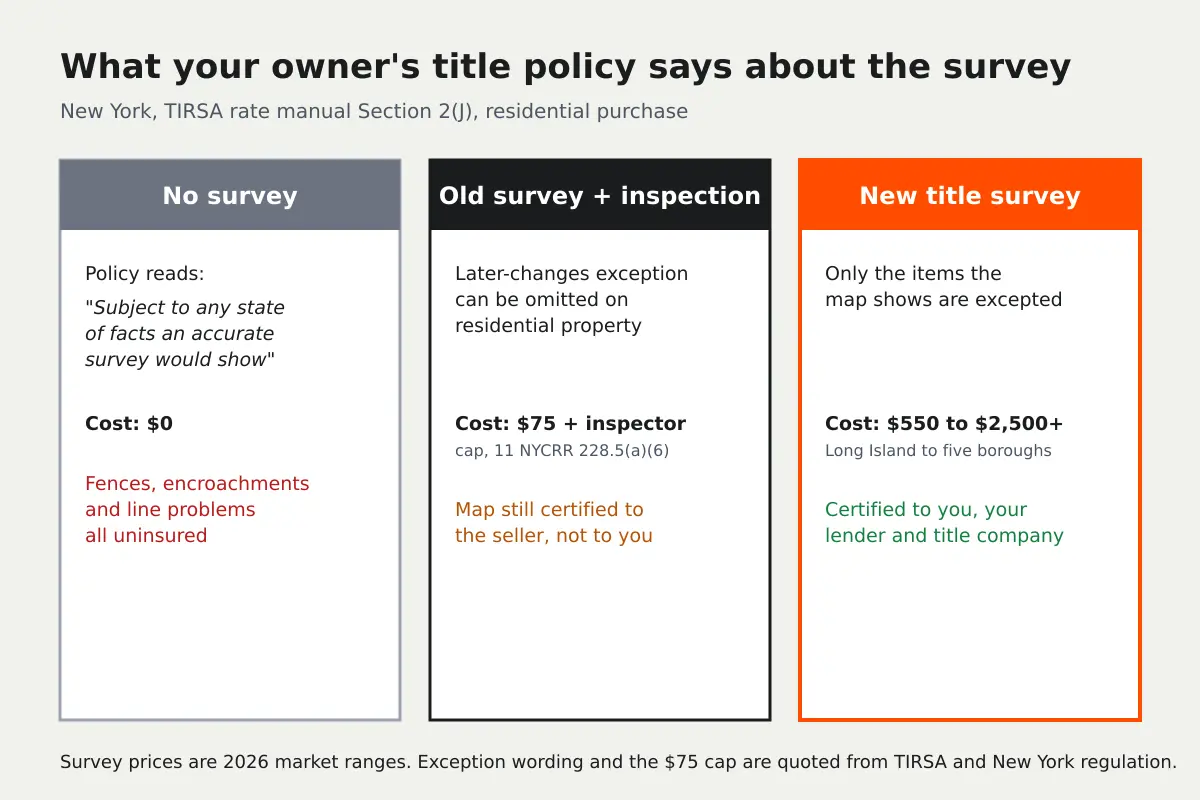
This is the decision your attorney is really asking you to make. The TIRSA rate manual that prices New York title insurance (7th revision, effective October 1, 2024) spells out what happens on an owner's policy in each case.
| What you hand the title company | What your owner's policy says | What it costs you | What you are left exposed to |
|---|---|---|---|
| No survey at all | Subject to any state of facts an accurate survey would show | Nothing up front | Every encroachment, fence and line problem, uninsured |
| The seller's old survey, no inspection | Exception for changes after the date of the existing survey | Nothing up front | Anything built or moved since that date, by you or the neighbors |
| The seller's old survey plus a survey inspection | The later-changes exception can be omitted on residential property | $75 plus the inspector's cost | Errors in the old survey itself, and a map certified to someone else |
| A new title survey certified to you | Only the specific items the survey shows are excepted | $550 to $2,500+ | Only what is on the map, which you can now negotiate before closing |
The exception wording is quoted from TIRSA Rate Manual Section 2, Rules, paragraph (J): "in the absence of a survey acceptable to the Company, the Policy shall contain the following language (or language of similar meaning): Subject to any state of facts an accurate survey would show." Paragraph (J)(1) lets the company charge to omit, by inspection, the exception for changes after an existing survey on residential property. Lenders are treated differently, which is why a deal can close with the bank fully covered and the owner holding a policy full of exceptions. The affidavit of no change that often goes with an old survey is explained on the New York land surveyors page.
Can I use the seller's old survey?
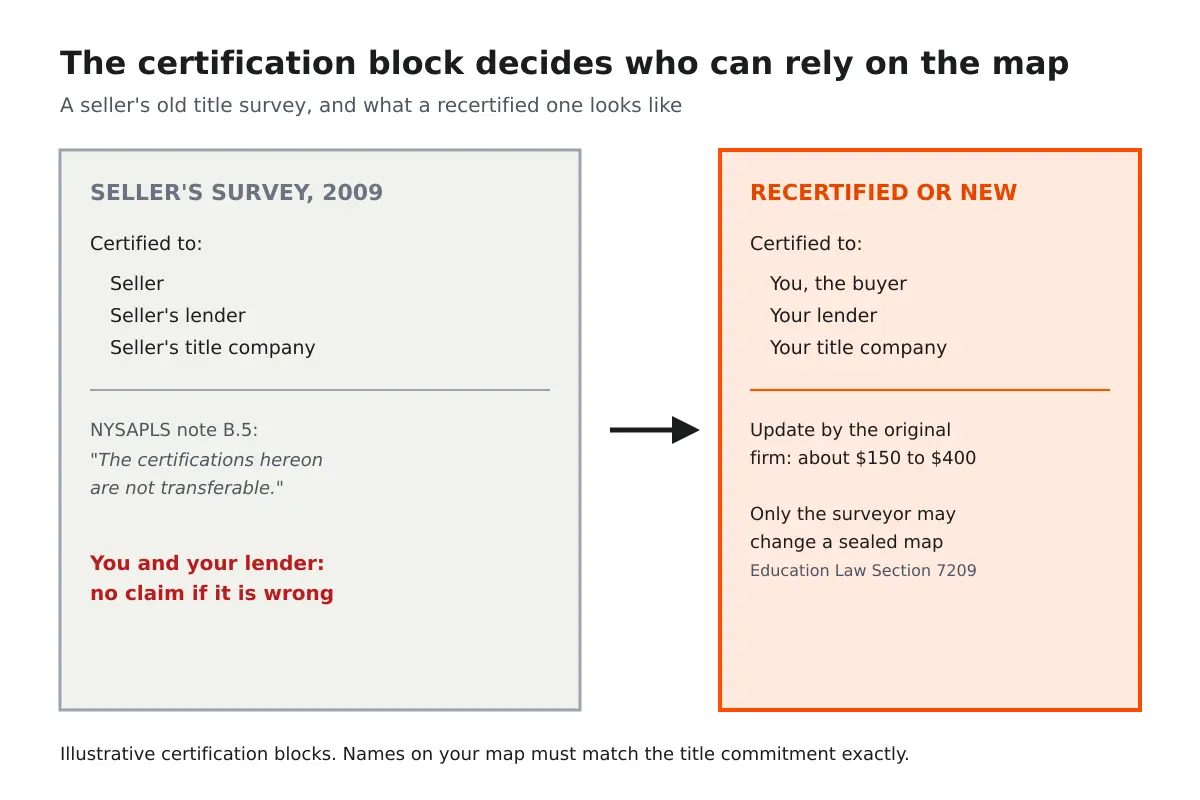
You can use it to get the title company comfortable, but you cannot rely on it the way the seller could. The surveyors' own Code of Practice is blunt. Standard note B.4 limits the certification to "persons for whom the boundary survey map is prepared, to the title company, to the governmental agency, and to the lending institution listed on this boundary survey map." Note B.5 adds that the certifications "are not transferable." Section A.4 says certifying a survey is for "a specific transaction" and is not meant to extend to "additional title companies, lending institutions owners or subsequent owners."
So a 2009 survey certified to the seller, the seller's bank and the seller's title company tells you something useful about the lot, and gives you no claim against the surveyor if it is wrong. Your new lender is not on it either. That is why the cheapest real fix is usually to call the firm that made the old survey and ask for an update and recertification to you, your lender and your title company. They already have the research and the field notes, so it typically runs $150 to $400 instead of a full new survey.
Do not let anyone simply edit the PDF to add your name. Education Law Section 7209 requires a warning that altering a sealed item is a violation unless done under a licensed engineer or land surveyor, and a surveyor who alters one must add an "altered by" notation, signature, date and description. The code's standard note B.2 repeats it: unauthorized alteration of a sealed survey map "is a violation of section 7209, sub-division 2." A doctored map is worse than no map, because the title company may reject it the week of closing.
What a survey reading turns up on NYC and Long Island houses
When the survey reaches the title company, an examiner reads it and adds an exception for each item that crosses or crowds a line. These are the items that come up again and again on dense city lots and older suburban ones. Each one is something to raise with your attorney before closing, not after.
- Fences off the line. A fence a foot onto the neighbor's lot, or theirs onto yours, is the single most common item. The survey shows the offset; your attorney decides whether to insure over it or ask for a fence agreement.
- Stoops, steps and areaways past the front line. On row houses the front steps and areaway often sit on the city side of the lot line. Usually tolerated, but it will appear on the map and in the policy.
- Party walls and shared driveways. Attached and semi-attached houses share walls and often a driveway or a common drive easement. The survey shows where the wall centerline and the drive fall, which is what the title examiner needs to decide what to except.
- Sheds, garages and decks into the side or rear yard. On Long Island lots a detached garage or shed close to the line can trip a zoning setback issue as well as a title one.
- Retaining walls and grade changes at the line. Whoever owns the wall usually owns the repair bill. The survey shows which side it is on.
- Overhead wires, utility poles and recorded easements. Easements of record found in the title search get plotted so you can see whether they run under the house or a planned addition.
- Measurement differences from the deed. Lot dimensions on the ground that differ from the filed map or deed by more than a few inches get noted, and occasionally reveal an overlap with a neighbor's deed.
Why the NYC tax map or a county GIS parcel is not a title survey
Buyers sometimes pull the lot from the NYC Department of Finance digital tax map, or a Nassau or Suffolk GIS viewer, and ask whether that will do. It will not, and the map says so itself. The Department of Finance tax map printout states that it is "for information purposes only," that it "should not be used for boundary lines or location," and that "any use of this map for conveyances of property or any other legal proceeding is at the sole risk of the parties."
Only a licensed land surveyor can produce the map a title company will accept. New York Education Law Section 7204 says only a licensed person may practice land surveying, and every plat must carry the surveyor's seal and signature. You can check any surveyor in under a minute on the NYSED Office of the Professions license verification search. Profiles on Surveyors.io show the license number the surveyor entered and say on the page that we have not verified it, so run that lookup before you hire.
How to order a title survey without pushing your closing date
1.
Ask for the seller's survey the day you sign
Your attorney can request it with the contract. Note the date, the firm and who it is certified to. If the firm still exists, an update and recertification may be all you need.
2.
Decide what coverage you want
Use the table above: no survey, old survey with an inspection, or a new survey certified to you. If you plan a fence, addition or pool soon, the new survey pays for itself twice.
3.
Get quotes with the certification list written out
Each quote should name the parties the map will be certified to: you, your lender and your title company, exactly as they appear on the commitment. Missing names mean a second trip later.
4.
Book early in the contract period
Field work on a city lot is often a half day, but records research, drafting and the seal add time and spring is busy. Ordering in week one keeps the survey off the critical path.
5.
Send the sealed map to the title company and read the exceptions
Once the examiner reads it, ask your attorney to walk you through every survey exception added to the commitment, while there is still time to ask the seller to fix or explain them.
Title survey questions from New York buyers
How much does a title survey cost in NYC?
A new title survey in the five boroughs typically costs $900 to $1,800 for a detached house and $1,200 to $2,500 or more for an attached row house with party walls. On Long Island most one-family lots run $550 to $1,300. An update of an existing survey by the original firm is usually $150 to $400.
Do I need a survey to buy a house in New York?
No law requires one, but without an acceptable survey your owner's title policy will say it is subject to any state of facts an accurate survey would show, which leaves boundary and encroachment problems uninsured. Most New York buyers either order a new title survey or use the seller's survey with a title company inspection.
Who orders the title survey in a New York closing?
Usually the title company or the buyer's attorney orders it and the cost is passed through on the closing statement. You can also hire a licensed surveyor directly, as long as the map is certified to you, your lender and your title company by name.
Can I use the previous owner's survey?
The title company may accept it with a survey inspection and a seller's affidavit of no change, but its certifications do not transfer to you. Under the NYSAPLS Code of Practice the certification runs only to the parties named on the map and is not transferable, so you have no claim on the surveyor if it is wrong.
What is a survey inspection?
It is a title company check that nothing visible has changed since the date of an existing survey, used to remove the exception for later changes on a residential policy. New York regulation 11 NYCRR 228.5 caps the fee at $75 plus the out-of-pocket cost charged by the survey inspector.
What is a survey reading?
A survey reading is the title examiner's review of your survey. Each fence, stoop, wall, shed or easement that crosses or crowds a line becomes a specific exception in the title commitment, which your attorney reviews with you before closing.
Is a title survey the same as a mortgage survey?
Not quite. A title survey is a full boundary survey made for a property transfer and certified to the buyer, lender and title company. A mortgage or location survey elsewhere in the country is often a cheaper drawing that only places the house on the lot. See the mortgage closing survey page for the difference.
Can the surveyor just add my name to the old survey?
Only the surveyor can, by recertifying it. Education Law Section 7209 makes it a violation for anyone else to alter a sealed survey map, and a surveyor who alters one must mark it "altered by" with a signature, date and description.
Three quotes beat six voicemails
Describe the parcel once. Your scoped request goes to licensed surveyors listed for your county and they quote it themselves. Posting is free for clients and quotes are never marked up.