Property survey for pool permits, final pool surveys and quotes from licensed surveyors
A property survey for a pool permit usually costs $500 to $1,500 and shows your lot lines, easements and the pool's distance to each line. Whether you need a new sealed survey, an existing one or none depends on the permit office: Phoenix asks for a survey only when the pool sits within two feet of a setback, while Palm Coast, Florida wants a sealed topographic survey before final inspection. Check your town's pool checklist, then get quotes from licensed surveyors who work there.
Licensed surveyors · scoped requests · free for clients Up to 3 quotes, matched to your parcel
The price range and turnaround for the job you describe appear here.
Traverse
Estimate for ,
typical local range · on site to drawing
A published range for this type of work, not a quote. Send the request and surveyors listed for your county reply with their own price.
Free for clients · You choose who to talk to
Who needs a property survey for a pool, and what you are paying for
You need one when your permit office will not issue a pool permit without a drawing that shows exactly where the pool goes relative to your property lines. An in-ground pool is a permanent structure. It has to sit a set distance from every lot line, stay off utility and drainage easements, clear a septic system if you have one, and in many towns keep its pump and filter pad out of the setback too. None of that can be checked against a guess about where the line is.
What you pay a licensed surveyor for is the line itself, located on the ground with corner markers found or set, plus the recorded easements plotted on a drawing your pool contractor can design to. The contractor or the surveyor then draws the pool, deck and equipment on that survey for the permit. In some towns that is the end of it. In others the surveyor comes back after the shell is built for a final pool survey that proves where it actually went.
Who buys this: a homeowner who has signed with a pool builder, often with a $50,000 to $100,000 project and an excavation date, and who just found out the permit counter wants a survey. The fastest path is a surveyor who already knows your town's pool checklist. Do you need a survey to build a pool covers the yes or no question; this page is for pricing and booking it.
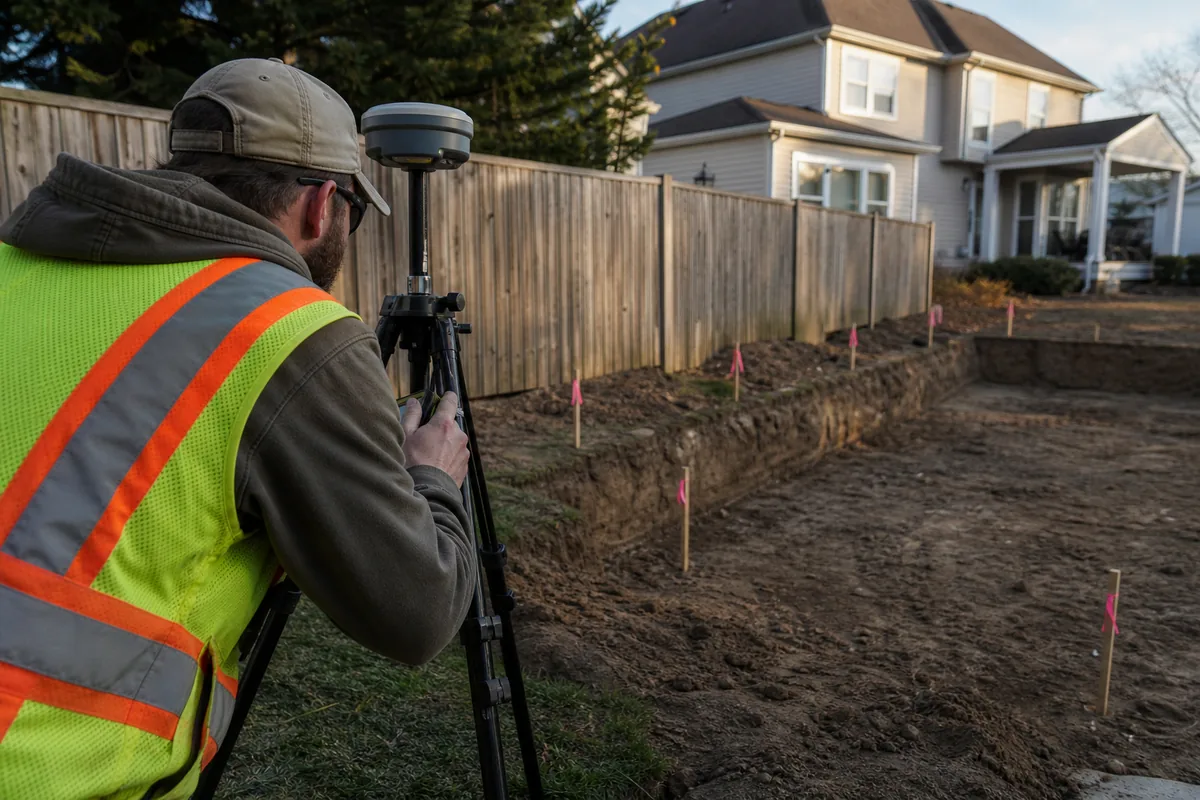
How much does a survey cost for a pool?
Most pool projects need one boundary survey before the permit and, in some towns, one short return visit after the pool is built. The topographic version only applies where the permit office asks for drainage grades. These are market ranges, not fixed fees.
| What you are ordering | Typical cost | When |
|---|---|---|
| Boundary survey with easements, standard residential lot | $500 - $1,500 | Before the permit |
| Update of an existing survey by the firm that made it | $150 - $400 | Before the permit |
| Pool, deck and equipment drawn on the survey (plot plan) | $150 - $400 add-on | Before the permit |
| Topographic survey with spot grades for drainage review | $900 - $2,500 | Before the permit or before final |
| Staking the pool corners or checking setbacks before the dig | $300 - $600 | Before excavation |
| Final pool survey (as-built location of the finished pool) | $400 - $900 | Before final inspection |
| Elevation certificate, if the lot is in a flood zone | $400 - $900 | Permit or final |
The cheapest path is usually an update of a recent survey by the original firm, if your town accepts it and nothing has been built since. Ask every quote whether corner markers, the easement research and the plot plan are included, because a low number that leaves one of them out is not the same product. National context is in the land survey cost guide.
What nine permit offices actually ask for
There is no national pool survey rule. Here is what nine real pool checklists require, read from each office's own form. The point is how much they disagree: some want no surveyor at all, some want a sealed topographic grid, and some will not close your permit without a second survey.
| Permit office | What it requires | When | Who prepares it |
|---|---|---|---|
| Phoenix, AZ | Survey only if the pool is less than 2 ft from or into a required setback; otherwise an owner or contractor survey waiver | Corners verified or set before the footing inspection | Arizona registered land surveyor |
| Palm Coast, FL | Site plan with setbacks to every line at application; final topographic survey with elevations on a 20 ft grid and along property lines | Final survey before the final inspection | Licensed Florida surveyor and mapper, sealed |
| Clear Lake Shores, TX | Stamped property survey with a 7 ft topographic grid on the work area and along the lines, 5 ft into neighbors | Before permit review | Registered professional land surveyor |
| East Rockaway, NY (Nassau) | Two copies of a current survey plus a plot plan with setbacks and fencing; a final survey after the pool is installed | Final survey to close the permit | Surveyor |
| Huntington, NY (Suffolk) | Two copies of a recent complete survey with the pool and its setbacks; 5 ft minimum to the property line for pool and equipment | Before the permit | Survey by a surveyor, plot plan by applicant |
| Lockport, NY | Survey of the property showing where the pool goes with setbacks marked | Before the permit | Not specified |
| Glen Rock, NJ | Three copies of a current survey; site plan prepared from a survey and topographic survey with elevation datum; $2,000 engineer escrow | Before the permit | Plans sealed by a NJ architect or engineer |
| Frisco, TX | Plot plan with the pool, deck and equipment, setbacks from the lines and distance to the house foundation | Before the permit | Applicant, no surveyor named |
| San Antonio, TX | Scaled site plan with lot size, easements and distances from the pool to every line and structure | Before the permit | Applicant, no surveyor required |
Read from the Phoenix "Pool, Property Survey Requirements" form, the Palm Coast building page, the Clear Lake Shores new pool checklist (rev. 4, 2021), the East Rockaway, Huntington, Lockport, Glen Rock, Frisco and San Antonio pool application documents. Rules change, so confirm on your own permit office's current checklist. Where a town does not require a surveyor, the plot plan still has to put the pool in the right place relative to lines you can prove, which is why most builders ask for a survey anyway.
Do you need a final survey after the pool is built?
In a growing number of towns, yes. East Rockaway on Long Island tells applicants up front that a final survey will be required after the pool is installed to close out the permit, and lists it with the electrical certificate as a condition of the certificate of compliance. Palm Coast, Florida requires a sealed topographic final survey, with interior elevations on a grid no wider than 20 feet and elevations every 20 feet along the property lines, before staff will even schedule the field inspection that comes ahead of the final. Durham, North Carolina can ask for a sealed as-built survey before it issues the certificate that lets you use the pool.
The reason is simple. A pool dug two feet closer to the line than the plan showed is invisible on paper and obvious on a survey, and so is a deck that grew into an easement or a lot that now drains onto the neighbor. Towns that have dealt with those disputes stopped trusting the plan and started asking for proof.
Budget it from day one. A final pool survey is a short visit, usually $400 to $900, and it is far cheaper when the same firm that did the pre-permit survey returns, because their control and corners are already on the ground. Ask for both visits in one quote. It is the same logic as an as-built survey for a house, scaled down to the backyard.
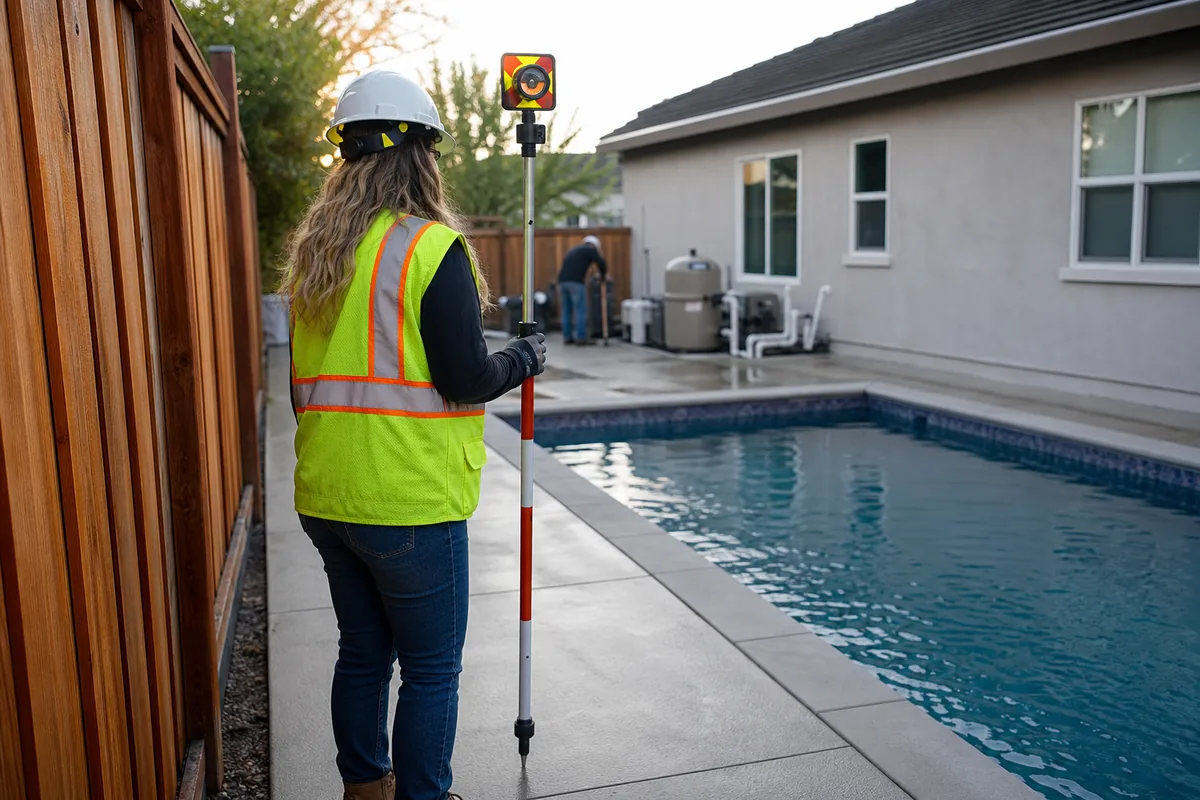
What makes a pool survey cost more or fail review
Most rejected pool permits come back for one of these. Ask the surveyor about each before the excavator is booked.
- A tight setback. Phoenix only asks for a sealed survey when the pool is less than two feet from a required setback, which tells you where the risk is. If your design pushes to the limit, the corners have to be proven, not assumed from a fence.
- Easements. Utility and drainage easements are recorded strips you generally cannot build a permanent structure on. A pool or deck inside one can be ordered out at your cost. The surveyor plots them from the plat and the title documents; an easement survey covers the harder cases.
- Grades and drainage. Where the town reviews drainage, as Palm Coast, Clear Lake Shores and Glen Rock do, a boundary survey is not enough. You are buying a topographic survey, which costs more and takes longer.
- An old survey. East Rockaway asks for a current survey and Huntington for a recent complete one. A closing survey from years ago that does not show your patio, shed or fence may be refused.
- The barrier. The model pool code requires a barrier at least 48 inches high around the pool. If that fence runs along the property line, the line has to be right, which is the same job as a survey for a fence.
- Flood zones and septic. A lot in a mapped flood zone may need an elevation certificate, and a septic tank or drain field sets its own separation distance the pool has to clear.
The pool builder's drawing is not a survey
The expensive assumption is that the layout sketch your pool company draws is a survey. It is a design drawn on top of whatever lines it was given. If those lines came from a county parcel viewer or an old mortgage drawing, the pool can be placed perfectly against lines that are in the wrong place. County parcel maps are made for tax assessment, not boundaries, and their lines can be off by several feet.
That is why San Antonio and Frisco, which accept an applicant-drawn plot plan, still require distances from the pool to every property line: the plan is only as good as the line it measures from. A licensed surveyor's job is to give the builder a line that will hold up when the inspector, a buyer's surveyor or the neighbor measures it later.
If you are not sure where your lines are, sort that first with a property line survey, then let the pool company design to it.
How to order a pool survey without paying twice
1.
Read your town's pool checklist
Find out whether it wants a current survey, a sealed survey, a topographic grid or a final survey. That one page decides whether you are buying a $500 job or a $2,500 one.
2.
Look for an existing survey
Check your closing package and ask the firm that made it for an update. If nothing has been built since and the town accepts it, this is the cheapest route.
3.
Get both visits in one quote
If a final survey is required, price the pre-permit survey and the final together from the same firm. The return visit is cheaper when their control is already set.
4.
Have the corners marked before the dig
Ask the surveyor to leave the corners visible, or stake the pool outline, so the excavator works from the line the permit was approved on.
5.
Book the final once the deck is poured
The surveyor locates the finished shell, deck, equipment pad and barrier, seals the drawing and you file it before the final inspection.
Pool survey questions
How much does a survey cost for a pool?
Plan on $500 to $1,500 for a boundary survey of a typical residential lot with easements plotted, plus $150 to $400 if the surveyor draws the pool on it. Towns that review drainage need a topographic survey at $900 to $2,500, and a final pool survey after construction usually runs $400 to $900.
Do you need a survey for a pool?
In most places you need a survey or a plot plan drawn from one to get a pool permit, because the pool has to clear setbacks and easements. How strict it is varies: Phoenix only requires a sealed survey near a setback, while Palm Coast, Florida requires a sealed topographic survey before final inspection.
Can I use my old survey for a pool permit?
Often, if it is legible, shows the current improvements and your town accepts it. Some do not: East Rockaway asks for a current survey and Huntington for a recent complete one. An update by the firm that made the original usually costs $150 to $400 and is the cheapest fix.
Who draws the pool on the survey?
Either the surveyor or the pool contractor. The surveyor supplies the property lines and easements; the pool, deck and equipment are then drawn to scale on that survey for the permit. Some offices, such as Glen Rock, NJ, require the pool plans themselves to be sealed by an architect or engineer.
What is a final pool survey?
It is a survey made after the pool is built that shows where the shell, deck, equipment and barrier actually are, with setbacks to the lines. Towns such as East Rockaway, NY require it to close the permit, and Palm Coast, FL requires a sealed topographic version with grades before final inspection.
How close can a pool be to the property line?
It depends on your zoning code. Huntington, NY requires at least five feet from the pool and its equipment to the property line, while many codes use side and rear setbacks for accessory structures. The survey matters most when the design runs close to the limit.
Does an above-ground pool need a survey?
Less often, but many towns still want a plot plan showing its distance to the lines and a compliant barrier at least 48 inches high. If the pool or its fence sits close to a line you are not sure of, a survey is still the safe step.
Three quotes beat six voicemails
Describe the parcel once. Your scoped request goes to licensed surveyors listed for your county and they quote it themselves. Posting is free for clients and quotes are never marked up.